


A broken garage door spring is a stop-use problem. Leave the door where it is, stop using the opener, and keep people, pets, and vehicles clear. Do not adjust the spring or try to force the door open. Garage door springs store significant tension and should be replaced by a trained technician.
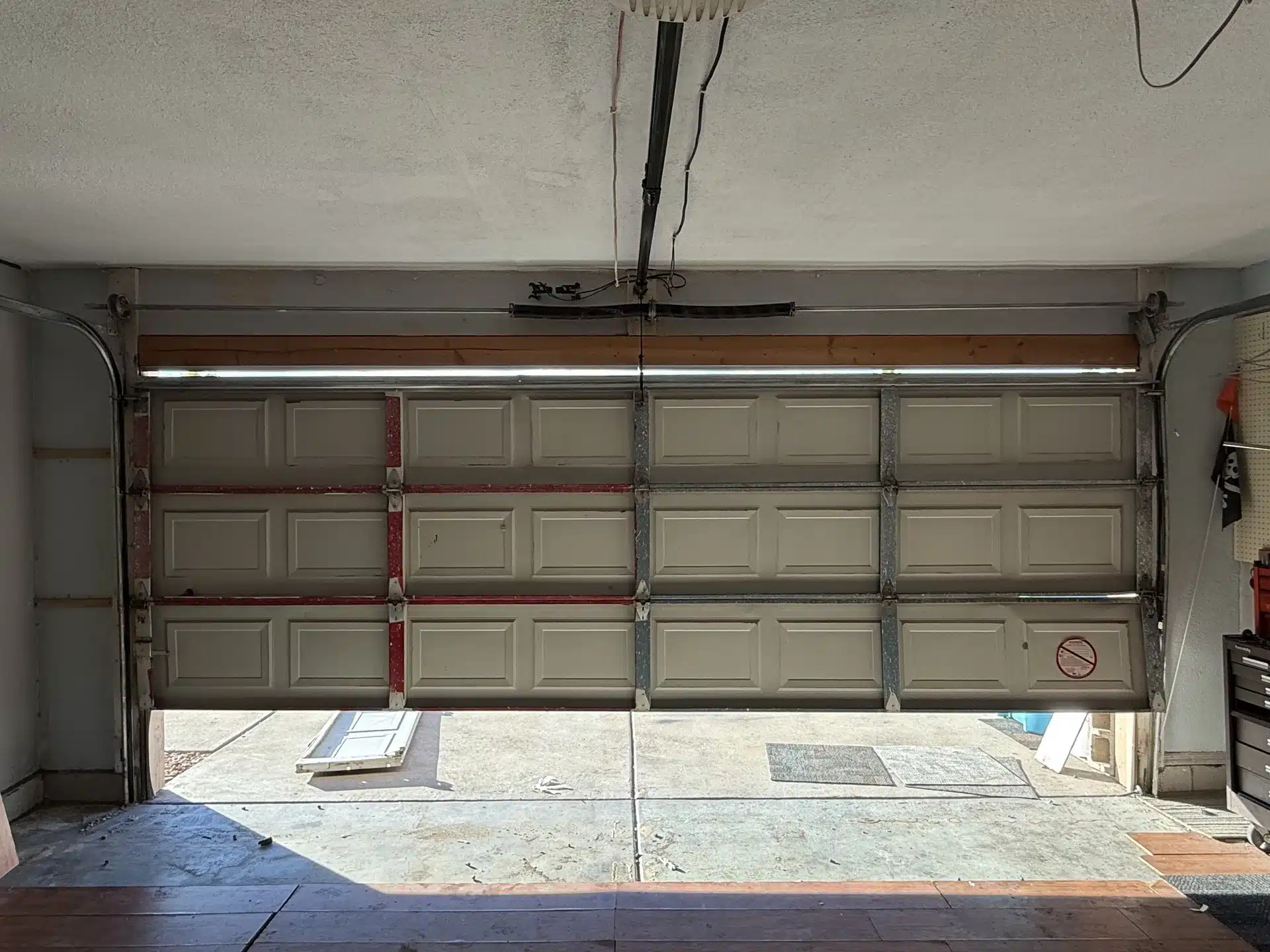
A spring often breaks with a loud bang, but the noise is only one clue. The door may suddenly feel extremely heavy, open only a few inches, sit unevenly, or cause the opener to strain without lifting it.
The important thing is not to keep testing the door. Once the counterbalance system has failed, continuing to operate it can turn one broken part into damage elsewhere in the system.
How can you tell if a garage door spring is broken?
A broken spring changes how the weight of the garage door is supported. Springs counterbalance the door so the opener does not have to lift the full weight on its own. When a spring fails, the difference is usually obvious.
Common signs include:
- A loud bang or snapping sound from the garage
- A visible gap in a torsion spring above the door
- A garage door that suddenly feels much heavier
- A door that rises a few inches and stops
- An opener that hums or strains without lifting the door
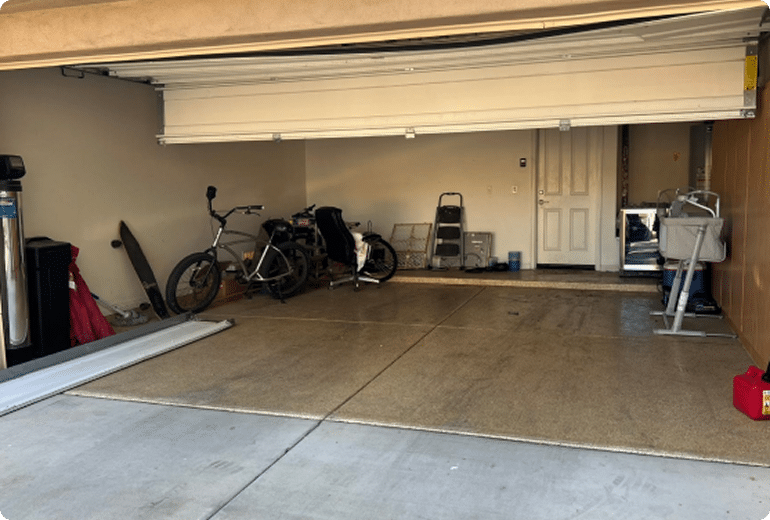
- A door that sits crooked or moves unevenly
- A loose or damaged lifting cable
Do not assume the opener has failed just because the motor runs and the door does not move. LiftMaster specifically notes that an opener that strains to operate the door can indicate an out-of-balance door or broken springs.
Torsion springs and extension springs fail differently
Most homeowners do not need to identify the spring type before calling for repair, but it helps to know what you are looking at.
Torsion springs are mounted on a shaft above the garage door. When one breaks, you can often see a gap where the coil has separated.
Extension springs run alongside the horizontal tracks and stretch as the door moves. Extension-spring systems should have safety cables that help contain the spring if it breaks. DASMA recommends having missing or damaged safety cables addressed by a trained technician.
What should you do immediately after a garage door spring breaks?
The safest response is simple: stop operating the door.
Stop using the garage door opener
Do not keep pressing the wall button or remote to see whether the opener can lift the door.
The opener is designed to move a properly balanced garage door. It is not a substitute for the spring system. Repeated attempts can place unnecessary load on the opener and other door components.
Leave the door where it is
If the garage door is closed, leave it closed until it can be inspected.
Do not try to muscle the door open just because you need to get a vehicle out. Without the spring doing its share of the lifting, the door can be far heavier than expected.
If the door is already open or partly open, keep everyone clear of it and call for service. Do not pull the emergency-release cord on a raised, damaged door. Manufacturer instructions generally call for disconnecting the opener with the door closed because an unbalanced door can move unexpectedly.
Keep people and pets away
A broken spring can affect more than the spring itself. The door may be poorly supported, cables may become loose, or the door may sit unevenly in the tracks.
Do not let children, pets, or anyone unfamiliar with the problem pass under or handle a damaged door.
Do not touch the spring or cable system
Garage door counterbalance components operate under high tension. DASMA identifies the spring system as one of the most dangerous parts of a garage door and recommends that repairs and adjustments be performed by trained door-system technicians.
That includes trying to:
- Wind or unwind a torsion spring
- Move spring cones or brackets
- Adjust lifting cables
- Reattach a loose cable
- Substitute makeshift tools for winding bars
- Change spring tension to make the door easier to lift
This is not a good DIY diagnostic area. You do not need to determine the spring size or tension yourself before calling.
Can you open a garage door with a broken spring?
You should not force a garage door open when its spring is broken.
The spring system is what counterbalances the weight of the door. Without it, a door that normally feels easy to move can become extremely heavy. A broken spring can also leave cables or other lifting components in an unsafe position.
If a vehicle is trapped inside, tell the garage door company that when you call. Also tell them:
- Whether the door is fully closed, partly open, or raised
- Whether one side is higher than the other
- Whether a cable appears loose
- Whether you heard a loud snap
- Whether the opener still responds
Those details are more useful than repeatedly trying the opener.
Why do garage door springs break?
Garage door springs are wear components. Every complete opening and closing of the door counts as one cycle, and spring life is commonly rated in cycles rather than simply in years. Clopay notes that many standard residential springs are designed around 10,000 cycles, though spring designs and ratings vary.
That means two identical garage doors can reach spring failure at very different ages.
A household that opens the garage door several times a day uses spring cycles much faster than a household that rarely uses the door.
Other factors also matter, including:
- Spring design and cycle rating
- Door weight
- Proper spring sizing
- Corrosion or physical deterioration
- Condition of the rest of the counterbalance system
- How often the garage door is operated
For Phoenix homeowners, it is useful to separate spring wear from other desert-related garage door problems. Heat and dust can affect lubrication, weather seals, sensors, rollers, and opener operation, but a broken spring should still be diagnosed as part of the complete counterbalance system rather than blamed on the weather alone.
Should both garage door springs be replaced if only one broke?
If your door uses a matched pair of springs, replacing both is commonly recommended.
Both springs have usually performed roughly the same number of cycles. When one reaches the end of its service life, the other has experienced similar use.
DASMA specifically recommends replacing both springs on a two-spring system when one breaks. This helps keep the counterbalance system working efficiently and avoids leaving an older spring paired with a new one.
That does not mean every garage door needs two new springs. Some doors use a single-spring design. The technician should first identify how your specific door was engineered and what spring setup is appropriate for its weight and hardware.
What happens during a garage door spring repair?
A spring repair should involve more than removing one broken coil and installing another.
At Immediate Garage Door Services, the repair process starts by checking the spring system along with the parts affected by it. That includes the cables, rollers, tracks, door movement, and opener operation.
A typical visit follows three steps:
Inspect the door and lifting system
The technician confirms the spring failure and checks for related problems. A crooked door or loose cable can signal that more than one part needs attention.
Replace the failed spring system components
The replacement spring must match the door and counterbalance requirements. Spring selection is not based on visual size alone.
This is one reason spring replacement belongs with a trained garage door technician. The spring has to counterbalance the actual door correctly after installation.
Balance and test the door
The job is not finished simply because the garage door moves again.
The repaired door should be checked for balance and proper travel. The opener and safety system should also be tested after the mechanical repair.
That final check matters because a garage door opener should move a properly balanced door, not compensate for a poorly balanced one.
Does a broken spring mean you need a new garage door?
Usually, no.
A broken spring is a component failure. If the door sections, tracks, and other major parts are still in usable condition, the spring system can often be repaired without replacing the entire garage door.
Replacement becomes a separate conversation when the door itself has problems such as:
- Major section damage
- Significant deterioration
- Poor fit
- Repeated structural problems
- A system that no longer meets the home’s needs
If one spring broke on an otherwise sound door, start with a garage door repair diagnosis rather than assuming you need a complete replacement.
Can maintenance prevent a garage door spring from ever breaking?
No. Springs are mechanical wear parts, so maintenance cannot make them last forever.
What maintenance does is give a technician a chance to check door balance, hardware, cables, rollers, and other parts while the system is still operating.
Experts recommend professional inspection of older springs and caution homeowners against adjusting high-tension spring components themselves.
A tune-up is preventive service. Once the spring is broken, the door needs repair.
What should you tell the garage door technician when you call?
You do not need to diagnose the spring yourself. A few observations are enough.
Tell the technician:
- What happened before the door stopped working
- Whether you heard a loud bang
- Whether the door is open or closed
- Whether it sits crooked
- Whether you can see a gap in the spring
- Whether a cable is hanging loose
- Whether the opener still runs
- Whether a vehicle is trapped inside
A photo of the spring and the full garage door can also help communicate what you are seeing, but stay clear of damaged hardware when taking it.
Frequently asked questions about broken garage door springs
Is a broken garage door spring dangerous?
Yes. Garage door springs and related counterbalance parts operate under high tension. A broken spring can also leave the door unusually heavy or poorly supported. Keep clear of the damaged system and have spring and cable work handled by a trained technician.
Can the garage door opener lift the door after a spring breaks?
Do not rely on the opener to compensate for a broken spring. The opener is intended to move a balanced door. If it strains, hums, or lifts only a few inches, stop operating it and have the spring system inspected.
How long do garage door springs last?
Spring life varies by spring design and use. Many standard residential springs are rated around 10,000 cycles, with one cycle being a complete opening and closing of the door. Higher-cycle spring options also exist.
Should I replace both springs at the same time?
If the garage door uses a matched two-spring system and one spring breaks, replacing both is commonly recommended because both have experienced similar use. DASMA specifically recommends replacing both springs on a two-spring door.
Is a broken spring a same-day repair issue?
A broken spring should be addressed promptly because the door may be unusable, unsecured, or trapping a vehicle. Immediate Garage Door Services offers same-day repair appointments, subject to scheduling. Tell us the door’s position and whether vehicle access is blocked when you call.
Broken spring in Arizona? Stop using the door and get it checked.
If your garage door spring just broke, do not keep cycling the opener or try to adjust the spring yourself. Leave the door in place and keep clear of damaged hardware.
Immediate Garage Door Services provides garage door repair across Arizona, including broken spring, cable, opener, roller, and off-track problems. Call or text 480-259-9737 and tell us whether the door is open, closed, crooked, or blocking a vehicle.
Same-day repair appointments are available, subject to scheduling.